Automation
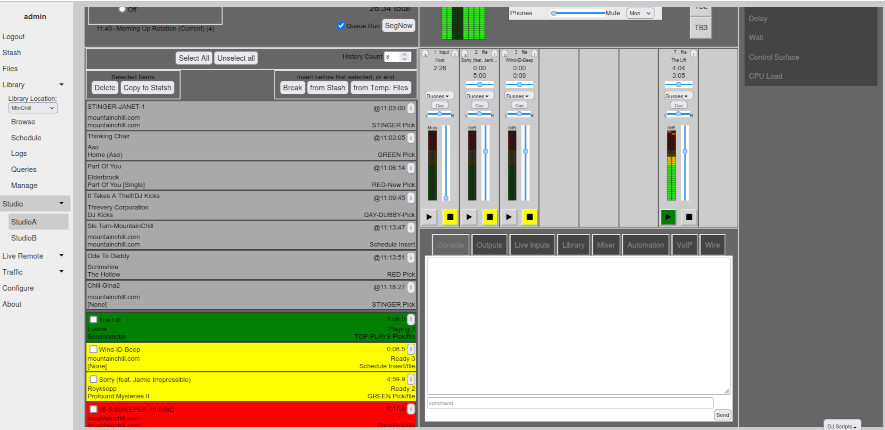
Schedules and plays broadcast audio consistently, while supporting the repeatable structure a 24-hour radio service demands. Playlists are built continuously rather than in advance using scheduled elements and algorithmic selections.
Red Mountain Radio · Broadcast Engineering
A purpose-built broadcast playout system paired with a resilient studio-to-transmitter link—designed to keep audio moving when ordinary Internet streaming would stumble.
01 · The source
AudioRack Suite is Red Mountain Radio’s modular, digital radio automation and live-assist system. Development began in the early 2000s, informed by direct experience in day-to-day broadcast operations rather than by a generic media-player model.
The system is designed to organize and play the elements that make up a radio hour: music, announcements, imaging, scheduled events, live-assist material, and the transitions between them. Its modular approach lets a station assemble a practical operating environment without treating every studio as though it were identical.
At Mountain Chill, AudioRack is the originating broadcast-audio source. Its continuous program output feeds the studio Red Mountain Radio RSP server, which prepares the audio for resilient delivery to the transmitter via an Internet studio-transmitter link.
Schedules and plays broadcast audio consistently, while supporting the repeatable structure a 24-hour radio service demands. Playlists are built continuously rather than in advance using scheduled elements and algorithmic selections.
Gives an operator direct control when the station is live, without abandoning the timing and organization of the automation environment.
Separates functions into practical components so the system can be adapted to the station rather than forcing the station into a rigid workflow.
02 · The transport
Red Mountain Radio’s custom Resilient Streaming Protocol is a one-way, IP/UDP-based media transport developed for dependable broadcast audio delivery across imperfect Internet links.
Conventional streaming treats lost packets as gone forever. That is a poor bargain for a studio-to-transmitter link: even a brief ISP interruption can become silence or a conspicuous glitch on the air. RSP adds redundancy and time diversity so short losses can be reconstructed downstream.
Red Mountain Radio RSP is intentionally distinct from similarly named commercial streaming products. Here, it refers to Red Mountain Radio’s own broadcast-audio transport system.
03 · System architecture
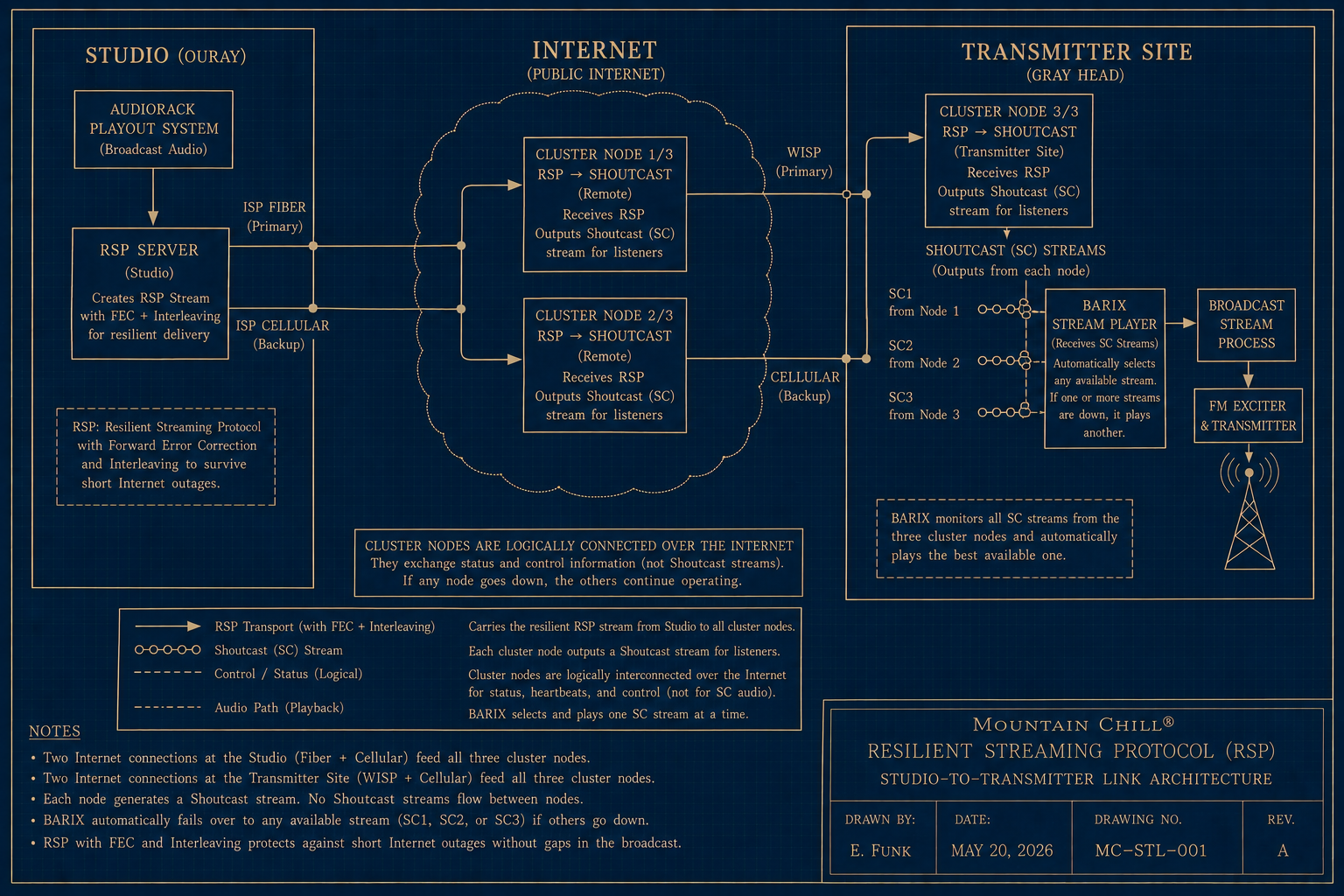
The architecture separates resilient transport from listener-compatible playback. AudioRack supplies the program; Red Mountain Radio RSP carries it to cluster nodes; each node produces an independent Shoutcast stream. One node is placed at the transmitter, and that is the primary streaming address for the Barix player, translating RSP to standard Shotcast locally.
AudioRack generates the station’s continuous broadcast program at the studio.
The studio RSP server adds forward error correction and interleaving before transport.
Fiber and cellular paths can reach all three logically connected cluster nodes over the public Internet.
Each node creates a Shoutcast stream. The Barix (or similar) stream player uses whichever stream remains available, the transmitter site node (fed with RSP) is the primary high reliability node. Other nodes can be used for listener Shoutcast streaming.
04 · The resilience mechanism
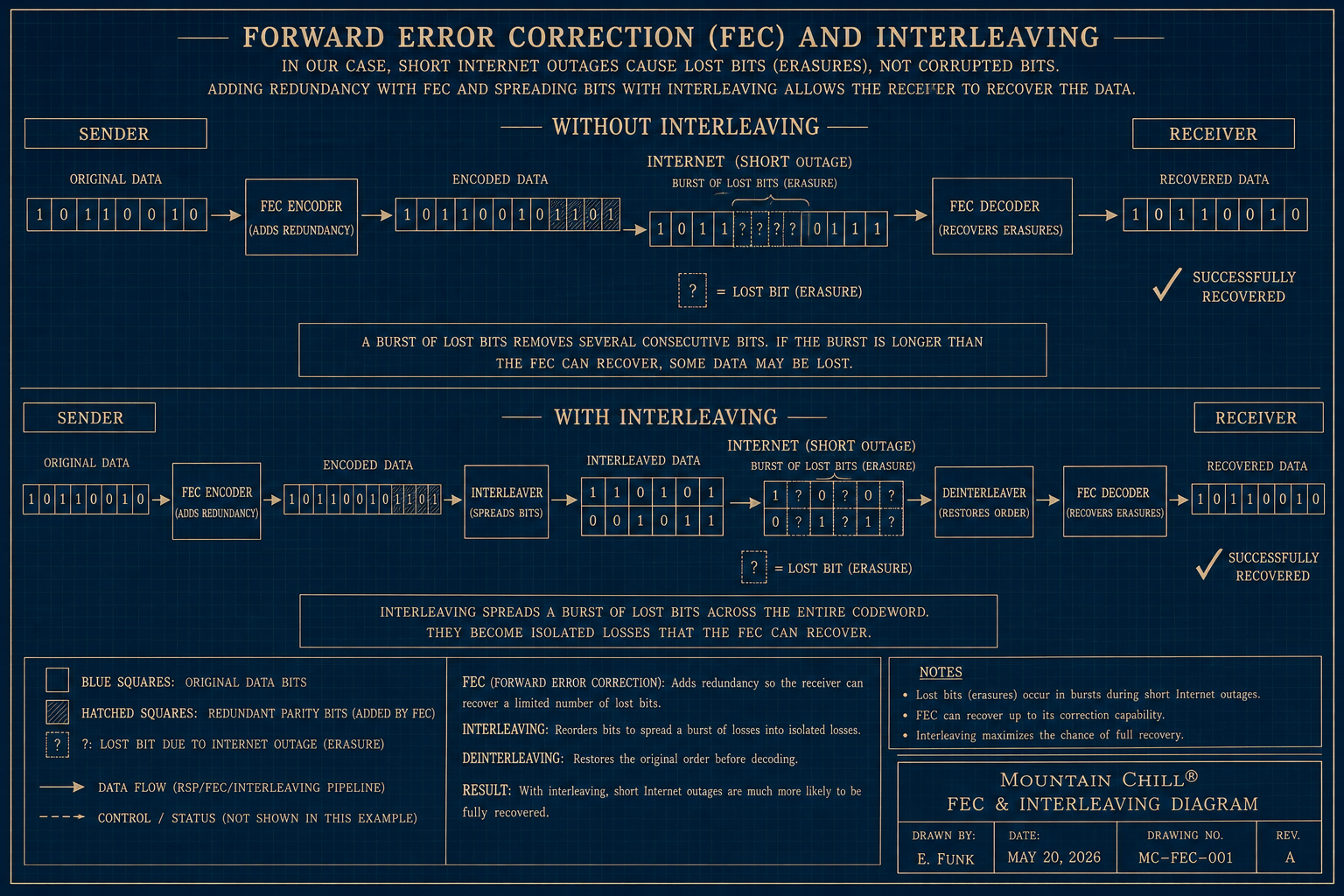
Short Internet outages tend to erase adjacent packets in a burst. Forward error correction adds redundant information; interleaving rearranges the transmitted data so one burst is spread across several protected groups after deinterleaving, allowing for correction via FEC.
That distinction matters. FEC can reconstruct only a limited number of losses within a code block. Without interleaving, one outage may wipe out too much of a single block. With interleaving, the same outage becomes a smaller number of losses in many blocks—exactly the sort of damage FEC handles well.
05 · Why the pieces belong together
AudioRack and Red Mountain Radio's RSP protocol solve different parts of the same broadcast problem. AudioRack creates and manages the program. RSP protects that program while it crosses networks the station does not control.
The cluster-node layer then converts the protected transport into standard Shoutcast streams that readily available receiver hardware can play. The result is not dependence on one “perfect” connection. It is a system designed to keep working after ordinary components stop being perfect—which they eventually will, usually five minutes before a very important announcement.
Red Mountain Radio · Ouray, Colorado
AudioRack and Red Mountain Radio RSP grew from practical station operations: maintaining a continuous, high-quality air signal across mountain geography, remote infrastructure, and Internet connections that occasionally develop personalities.